 Posted by
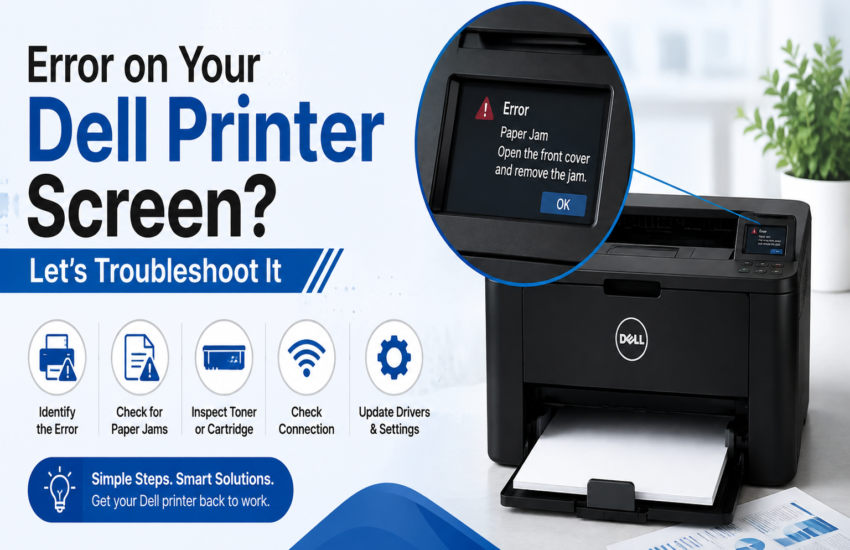
 A printer error can bring office work, billing, documentation, and production activities to a sudden stop. If your Dell printer is showing an error message, warning light, paper jam notification, or connectivity issue, the problem may not always require professional servicing.
Many common Dell printer errors can be identified and resolved through a few systematic troubleshooting steps.
This guide explains the most common Dell printer errors, their possible causes, and practical solutions to get your printer working again.
Common Dell Printer Errors and What They Mean
Dell printers can display different types of errors depending on the model and the underlying problem. Some of the most common issues include:
- Paper jam errors
- Toner or cartridge errors
- Printer offline errors
- Connectivity errors
- Print spooler errors
- Driver-related errors
- Network connection problems
- Scanner or hardware errors
- Low toner warnings
- Cover-open or tray errors
Understanding the type of error is the first step toward finding the right solution.
1. Check the Printer Display for the Exact Error
Before changing any settings, carefully read the message displayed on the Dell printer screen.
The error may indicate a specific issue, such as:
- Paper Jam
- Replace Toner
- Load Paper
- Printer Offline
- Cover Open
- Cartridge Error
- Communication Error
If the printer provides an error code, note it down. The exact code can help identify whether the issue is related to hardware, consumables, connectivity, or software.
2. Restart Your Dell Printer
A simple restart can resolve temporary communication and system errors.
Turn off the printer and unplug it from the power source. Wait for approximately 30 seconds before reconnecting it.
Then:
- Connect the printer to the power supply.
- Turn it on.
- Wait until the printer completes its startup process.
- Try printing a test page.
Restarting can clear temporary errors and re-establish communication between the printer and computer.
3. Check for Paper Jams
Paper jams are among the most common causes of printer errors.
Open the printer’s access panels and check for:
- Paper stuck inside the paper path
- Torn pieces of paper
- Incorrectly loaded paper
- Overfilled paper trays
- Folded or damaged sheets
Remove the paper carefully without pulling aggressively, as excessive force can damage internal printer components.
After clearing the jam, close all covers properly and restart the printer.
4. Check the Toner or Ink Cartridge
If your Dell printer displays a toner-related error, check whether the cartridge is:
- Empty
- Incorrectly installed
- Not recognized
- Damaged
- Near the end of its usable life
Remove the cartridge and reinstall it carefully.
If the error continues, the cartridge may need replacement or the printer may require further inspection.
For laser printers, avoid touching sensitive cartridge components unnecessarily, as improper handling can affect print quality.
5. Check the Printer Connection
Connectivity problems can make a perfectly functional printer appear offline.
For a USB-connected printer, check:
- USB cable connections
- USB port condition
- Cable damage
- Whether the printer is detected by the computer
For a network printer, check:
- Wi-Fi or Ethernet connection
- Network status
- Printer IP address
- Router or network availability
If multiple computers cannot connect to the printer, the issue may be related to the network rather than the individual computer.
6. Check Whether the Printer Is Offline
Sometimes Windows may automatically mark a printer as offline.
On your computer, check the printer status and make sure the correct Dell printer is selected as the default printer.
Also check whether there are any paused or failed print jobs in the print queue.
Clearing stuck print jobs can often restore normal printing.
7. Clear the Print Queue
A corrupted or stuck print job can prevent new documents from printing.
Open the printer’s print queue and check for pending documents.
Cancel documents that are stuck or repeatedly showing an error.
If the queue does not clear normally, restarting the computer and printer can help reset the printing service.
8. Update or Reinstall the Printer Driver
An outdated, corrupted, or incompatible printer driver can cause communication problems.
Driver-related symptoms may include:
- Printer not detected
- Documents stuck in the queue
- Incorrect print output
- Printer repeatedly going offline
- Printing stopping unexpectedly
Install the appropriate driver for your Dell printer model and operating system.
Before installing a new driver, it can also be useful to remove an outdated printer installation if the existing driver has become corrupted.
9. Check the Printer’s Default Settings
If your computer has multiple printers installed, it may be sending the document to the wrong device.
Check:
- Default printer selection
- Printer name
- Paper size
- Print orientation
- Number of copies
- Color or monochrome settings
Selecting the correct Dell printer can immediately resolve some apparent printing problems.
10. Check for Cover or Tray Errors
Some Dell printers will not operate if a cover, tray, or access panel is not correctly positioned.
Check that:
- Front and rear covers are completely closed.
- Toner access doors are properly secured.
- Paper trays are correctly inserted.
- The paper guides are positioned correctly.
- No foreign objects are blocking the printer mechanism.
Even a slightly open cover can trigger an error message on certain printer models.
11. Check the Paper Type and Size
A printer may generate an error when the paper loaded does not match the selected print settings.
For example, if the printer is configured for A4 paper but the tray contains another size, the printer may stop the print job.
Make sure the paper size selected in the document and printer settings matches the paper loaded in the tray.
Also avoid using excessively damp, curled, folded, or damaged paper.
12. Reset the Printer When Necessary
If basic troubleshooting does not resolve the issue, a printer reset may help.
However, the reset procedure can vary depending on the Dell printer model.
Before performing a factory reset, check the printer’s model-specific instructions because resetting the device may remove network settings and other customized configurations.
When Should You Contact a Printer Service Professional?
If the error continues after basic troubleshooting, the problem may involve a hardware component.
Professional inspection may be required when you notice:
- Repeated paper jams
- Unusual mechanical noise
- Burning smell
- Printer not powering on
- Persistent hardware error codes
- Poor print quality despite a new cartridge
- Fuser-related problems
- Internal component damage
- Printer repeatedly restarting
- Network hardware failure
Avoid repeatedly operating a printer that shows signs of physical or electrical damage.
Preventing Dell Printer Errors
Regular maintenance can reduce unexpected printer downtime.
Follow these practices:
Keep the Printer Clean
Dust and paper particles can accumulate inside the printer and affect rollers, sensors, and other components.
Use Suitable Paper
Use paper that matches the printer’s recommended specifications and storage conditions.
Replace Consumables on Time
Low-quality or exhausted toner cartridges can affect print quality and printer operation.
Avoid Overloading the Paper Tray
Do not exceed the recommended paper capacity.
Keep Drivers Updated
Using compatible printer drivers helps maintain reliable communication between the printer and computer.
Perform Regular Maintenance
Routine inspection and cleaning can help identify potential problems before they become major printer failures.
Final Thoughts
A Dell printer error does not always mean that the printer needs immediate replacement. Many common problems, including paper jams, offline status, toner errors, connectivity issues, and stuck print queues, can be resolved through systematic troubleshooting.
Start by identifying the exact error message, checking the physical printer, verifying the connection, clearing the print queue, and checking the printer driver.
If the error persists or indicates a hardware problem, professional printer servicing is the safer option.
The key is to identify the actual cause of the error rather than repeatedly restarting the printer or changing components without diagnosis.